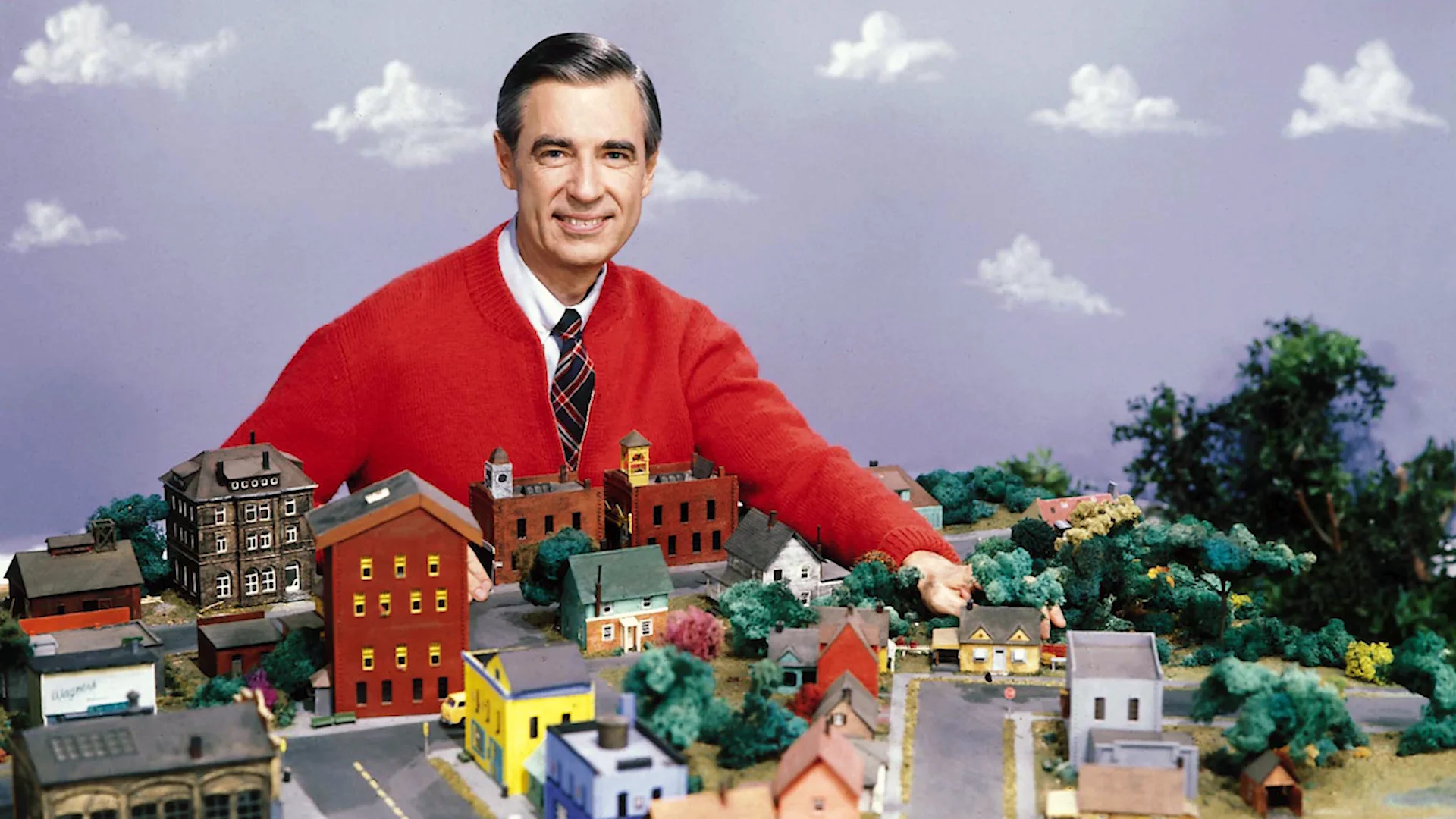
When I was a kid, I had a happy place: It was peaceful, it was slow-moving, and it involved a geriatric changing into a sweater before feeding the fish and playing with a train.
My happy place was Mister Rogers’ Neighborhood.
His cardigan sweaters were knitted by a mother who had died the year I was born, his voice was always calm and low, and his episodes were intentionally slow-paced. Despite all this, his influence sparked an unexpected lifelong adventure in me that’s just reaching its peak.
As you probably know, I started developing social-emotional learning materials tied to tabletop RPGs this summer. The story of how that came to be, however, goes back much earlier, to Mister Rogers’ Neighborhood.
Mister Rogers and the Power of Imaginative Play
Some of my very earliest memories, around the age of three, involved looking up at a giant, immovable early-’80s television and not being able to turn away. Mister Rogers had me captivated. I was so captivated, in fact, that I mistook him for my grandfather, who looked nothing like him, though he had that same thoughtful, empathetic, slow-placed speech pattern.
Though Mister Rogers usually waited on the trolley to take him to the Neighborhood of Make-Believe, I have distinct memories of him placing miniatures of key Make-Believe locations on his kitchen table in much the same way as a GM would when setting up a TTRPG session. This was huge for me, because it was the same way I played with my own toys and action figures. In one episode, he even showed how one could get to the Neighborhood of Make-Believe by using paper cups and other objects lying about the kitchen. No matter what vehicle you took, imagination was the gateway to wonder.
The characters found in the Neighborhood of Make-Believe could easily be found at the gaming table. Daniel Tiger thrived on sharing his feelings openly, checking in with those around him to ensure that they were okay. King Friday’s lawful alignment made him a source of stability at times and an obstacle at others. Lady Elaine Fairchilde–who always terrified me–was an agent of chaos, shaking things up for those around her in ways that kept the narrative dynamic.
Through Daniel Tiger and Mister Rogers himself, the show modeled emotional literacy and perspective-taking. Rather than simply saying, “think about how the other guy feels,” Mister Rogers’ Neighborhood would take you to different places, people groups and life experiences through Picture-Picture documentary footage, children’s books and visits to Mister Rogers’ television neighbors. In a world that told men to keep their cards close to their chests, Mister Rogers offered a very different alternative, and that resonated profoundly with me.
Though I didn’t realize it at the time, Mister Rogers would later help me learn how to narrate feelings and embody characters in grad school when I learned how to write screenplays. It made me a better newspaper journalist as I sought to find both distinction and connection in my interviewees. Mister Rogers’ reverence toward empathy made me an educator known for connecting with the “problem students” who had previously seemed irredeemable. The perspective gained from different people groups–with some differing motivations and some surprising commonalities with me–made me a better storyteller in general. It made me a better Game Master.
The Gaming Portal Opens
I imagine few people in the American South can say they discovered Dungeons & Dragons in church, but I did just that. When my son was a kid, his minister approached me one Sunday and asked if he could play. As the son of a Southern Baptist minister during the height of the Satanic Panic, I had some reservations. I told him I’d need to do some research and then I’d get back to him.
After hours of poring over news articles and modern reflections, I discovered that the tabletop gaming portion of the Satanic Panic came from about five key opportunistic figures, a misreported “death” (of someone who turned out to be alive once the cameras turned off), and the new concept of a 24-hour news channel needing more content to keep their growing audience returning.
(I’ve made a more extensive deep-dive into this history lesson in a previous blog post.)
Once I gave in and played D&D with my son, it resonated instantly. Those same values that Mister Rogers taught me were resurfacing at the gaming table. We were telling a story collaboratively as Mister Rogers had invited us to do in every episode. Though half of us at the table were dudes raised in the ‘80s, we were expressing our emotions–just like Mister Rogers had taught us. We allowed ourselves to immerse fully into an imaginative world, just as we had as children.
We didn’t need a trolley to transport us to a land of make-believe. That’s what the dungeon map was for. Though the vehicle was different, the heart of the whole experience stayed the same. Roleplaying creatively came naturally, because Mister Rogers had introduced me to so many people groups, and to the core of what made us all redemptively human.
To this day, TTRPGs continue to let me explore identity, bravery, compassion, and moral complexity. At varying times, playing out humanity in imaginary settings has been enlightening, cathartic, and therapeutic in ways that enriched my real-world life. It’s as if the baton of narrative and emotional exploration has been passed seamlessly from my childhood PBS viewings to my adult tabletop gaming.
Coming Full Circle
Now we fast-forward to this summer: When it dawned on me that I should consciously make this link between Rogers & Gygax (the creator of D&D) for the betterment of those who play. I’m now focused on developing gaming modules that intentionally teach self-awareness, empathy, and decision-making through gameplay. When I create an NPC, I do so with emotional depth in mind, and I design reflection prompts that distinctly relate to interactions with that NPC. Social-emotional learning isn’t an add-on to TTRPGs. It’s been there the whole time whenever the GM tells a good story. What I’m doing is simply surfacing the SEL on purpose. There’s a hidden lineage from the empathetic Daniel Tiger to the self-sacrificing Toby the Orc.
What Would Mister Rogers Say?
Mister Rogers was an ordained Presbyterian minister. What’s interesting is that the Satanic Panic was going strong during the height of his show’s popularity, but he never condemned D&D, TTRPGs or those whose imaginations took them to fantasy settings. I imagine if he was asked about the dangers of TTRPGs, he would recognize its creative potential in allowing players to explore in the same ways as his show. He would see in it another way for players to feel seen, heard, and empowered.
I never outgrew the Neighborhood of Make-Believe. A quick scan of my classroom wall–with a poster of Mister Rogers and Daniel Tiger–will confirm that. What I’m doing with my Patreon is simply expanding on the Neighborhood with my own stories, characters and set of virtues.
The heart of both Mister Rogers and TTRPGs is the courage to imagine better worlds and the practice of being the kind of person who belongs in them. If that sort of story interests you, won’t you be my neighbor?
Check out what I’m doing as an attempt to continue Mister Rogers’ legacy on my Patreon. If you’re intrigued, follow the Patreon for free. If you believe in what I’m doing (and it won’t put you in a place of financial difficulty), consider patronizing me each month so that I can continue to grow my efforts. Regardless of your choice, keep living out empathetic and purposeful stories. As Mister Rogers would say, “You’ve made this day a special day, by just your being you.”